
What the World Cup Teaches About Strategy, Execution, and Who Belongs in the Room
Every four years, the World Cup reminds us of something business keeps forgetting.
Strategy and execution are not the same job. And confusing who does which is how talented teams, and talented organizations, lose matches they should have won.
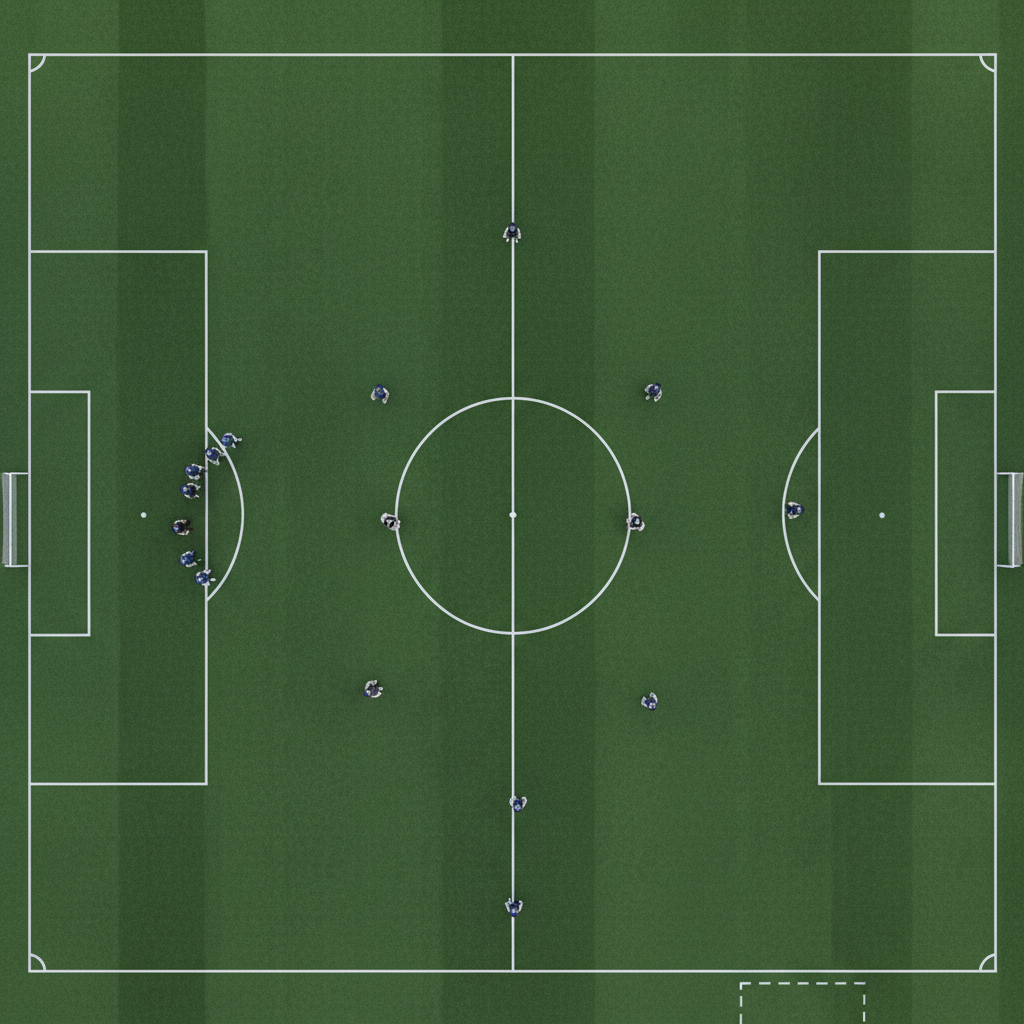
aerial view of a soccer field
Brazil and the Weight of Expectation
I will admit a bias here. As a Brazilian, watching the World Cup is not a leisure activity. It is closer to a national obligation, something carried in the blood across generations of joy and heartbreak. The 2014 semifinal still has a name. People do not forget.
What strikes me most, watching Brazil year after year, is not the lack of talent. The talent is extraordinary. What breaks down is something upstream of execution: the coherence between what the manager is trying to build and how the players are asked to carry it out on the pitch.
When those two things are misaligned, all the individual brilliance in the world does not produce a tournament. It produces spectacle without direction. Beautiful, sometimes. Enough to win consistently, rarely.
The Lesson That Transfers
Consider what a World Cup squad actually is: a head coach holding the strategic thread, a set of specialists executing within clearly defined roles, and a system that routes the right problem to the right person.
The center back is not asked to finish. The playmaker is not asked to defend the corner. Everyone is excellent in their lane, and the manager is the one person who sees the whole shape and holds it together across ninety minutes and a full tournament.
This is, in my view, the most honest description of what good advisory work looks like, particularly for resource-constrained organizations navigating real complexity.
One person holds the diagnostic thread and keeps the strategy coherent. Specialists carry the execution in their own domains. The arrangement is not about hierarchy. It is about fit, trust, and clarity of role.
Where Organizations Go Wrong
Most of the failures I have seen in data and AI engagements come from the same structural mistake the World Cup makes visible: the person responsible for strategy gets pulled into execution, or the person executing starts making strategic calls, and the whole shape collapses.
Sometimes a company brings in a large firm and gets a team of junior analysts executing a methodology no one has adapted to the actual situation. The strategy is in a slide deck, not in the room.
Other times they hire a single generalist and ask that person to do everything: diagnose, design, build, run. That is like asking your playmaker to also cover set pieces, manage fatigue, and adjust formation at halftime. The talent is real. The arrangement is wrong.
What works, in my experience, is what the best national teams get right in good years: a trusted strategist who stays in the room through the whole engagement, and a set of specialists that strategist can route execution to when the moment calls for their particular craft.

Table with a strategy laid out
What This Means for the People Who Refer Work
If you are an accountant, an attorney, a fractional CFO, or a platform partner, you have probably run into this situation. A client comes to you with a question that starts to touch data or AI, and it is adjacent to your work but not your lane.
The instinct is sometimes to stretch, to be the person with the answer. I understand the instinct. It comes from genuine care for the client relationship.
With that said, what actually protects that relationship is knowing who to route the work to. Not just someone competent, but someone that will stay in their lane, hold the strategic thread for this particular piece, and hand everything back to you without stepping on what you have built.
That is the arrangement I operate from. I come in as the diagnostician and strategic partner on the data and AI piece. I bring in specialists where my knowledge ends. And the client stays yours.
The World Cup analogy holds here too. The best referral relationships are not about finding someone to take over. They are about finding the right person for the right role, so the whole team wins the match it is actually playing.
On Luck, and What It Requires
One more thing the World Cup teaches, and this one I offer with some reluctance because it cuts against the tidy consulting narrative.
Luck is real. Draws, injuries, the angle of a post, the referee's sight line. These things matter, and no strategic framework eliminates them.

the ball going into the goal
What good strategy does is reduce the surface area where luck has to carry you. When your diagnostics are honest, your specialists are well-matched, and your execution is routed correctly, you are not dependent on fortune at every critical moment. You have earned the right to let the small margins fall where they fall.
That is what long-range work is actually about. Not the elimination of uncertainty, but the discipline to build something that does not require luck to hold together.
Here is hoping this tournament produces some good football. And yes, a part of me is still hoping Brazil figures it out.
Looking to rethink the your business strategy. Let’s talk.

Elias Kruger, MBA, is the Managing Principal of Long-Range AI Consulting LLC, where he provides advanced analytics strategy and AI-powered business transformations tailored for midmarket sectors, including community banks, credit unions, and fintechs. His career spans over 22 years of continuous reinvention across finance, data science, and enterprise AI leadership, notably serving as a Vice President at Wells Fargo where he co-led an internal analytics consulting program of over 60 analysts. As a diagnostic-first practitioner, Elias designs customized human-empowering AI-enabled solutions ranging from multi-agent orchestration, RAG-powered workflows to predictive modeling that drives operational efficiency and valuation increases. He is a frequent speaker at major industry conferences like Finnovate.